
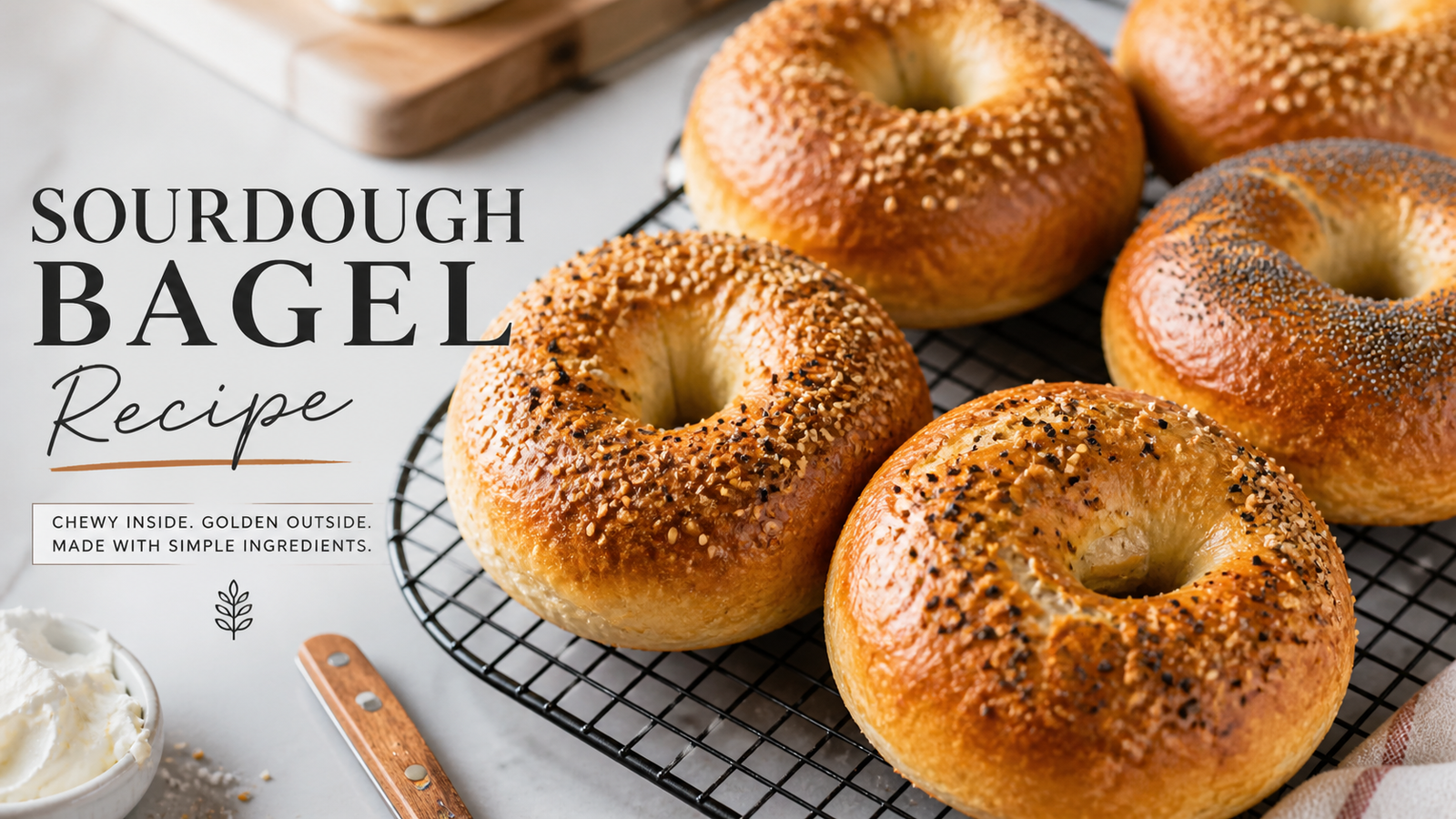
Sourdough Bagel Recipe
Sourdough bagels start where most bakers would least likely expect, which is not in bread flour or a bubbly sourdough starter and in patience. The crunchy texture and middle of the road flavor are achieved through naturally fermented grains, which store-bought bagels can simply not reproduce.
In comparison to commercial yeast recipes, an active starter is a mix of lukewarm water, salt and unbleached flour that is transformed into a dense crumb perfection. That shiny, crunchy outside with a mushy inside characterizes every bite worthy of New York to make.
I have baked dozens of batches of cinnamon raisin and Everything Bagel Spice, and the secret has always been: a peak active sourdough starter, proper development of gluten, and the essential boiling bath before baking.
Ingredients
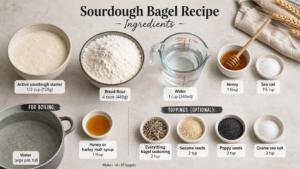
- Active sourdough starter- 1/2 cup (120g)
- Bread flour – 4 cups (480g)
- Water – 1 cup (240ml)
- Honey – 1 tbsp
- Sea salt – 1½ tsp
- For Boiling:
- Water – large pot, full
- Honey or barley malt syrup -1 tbsp
- Toppings (Optional):
- Everything bagel seasoning, sesame seeds, poppy seeds, or course sea salt – 2 tsp each.
Why Boil Before Baking Bagels?
Many home bakers overlook the boiling step without any real idea of what the boiling step can accomplish. When the dough is exposed to hot water, the outside of each bagel hardens within a few seconds securing the shape before it ever sees the inside of an oven.
The heat then changes the surface starsches in a gelatinous film – in other words, an adhesive layer that clings to whatever toppings you press on. This is a chemical action of seconds, but of seconds that decide the whole nature of your finished crust altogether.
It is that gelatinized shell that gives you that shiny crispy surface you want in a good bagel. You would take a bread roll out of the oven without that bath, it would be all right—good, yes, but without that unbelievable snap and gloss altogether.
Why Do You Put Sugar / Honey into the Boiling Water?
The boiling water step is one of the steps that most bakers overlook but it has a grave bearing. Caramelization is started by a spoonful of sugar or honey, directly upon the outside crust, and develops that indescribable crispness, before the bagel even enters the oven.
Honey acts like refined sugar does not, it adds darker, slightly floral undertones, which alone cannot be achieved through boiling water alone. This sweetness is absorbed quickly on the outside surface and the color and caramelization are locked into each ring perfectly.
The crispness obtained with sugar or honey is not cosmetic, but structurally sets the outside crust during the boiling process to ensure toppings stick well. It is a two-second choice that turns regular boiling water into a finishing tool that most home bakers have grossly undervalued.
Which Flour Should be used to make Sourdough Bagels?
If you’re just getting started with sourdough baking, our Sourdough Bread Machine Cookbook walks you through every step with beginner-friendly recipes and techniques.The majority of home bakers do not know that bread flour converts their sourdough bagels completely. Its superior protein content creates a sticky knit interior crumb, one that provides that most intensely chewy, dense bite, separating bakery worthy results and anything store bought. The architecture of proteins is crucial at this point.
Mixed flour makes less chew, more fluffy bagels – good, but never really good. In experienced hands, spelt flour or whole grain flour may be introduced into the dough to make it deep and with a tangy flavor, even though this requires a trustworthy and reliably active sourdough starter to responsibly manage the fermentation without losing the texture.
Personally, when using good quality sea salt and bread flour with a bubbling sourdough starter in the most active phase, the results are always flavorful and golden crust. The dough seems stiff – classic low hydration behavior – but that resistance is what makes bagels chewier, worth making.
Sample Baking Schedule Little Spoon Farm (68°F / 20°C Kitchen)
Knead the dough at 8 PM, cover the bowl and leave the dough to rest 1 hour. At 9 PM, give the bagel dough a final 30-second knead, and put it to an overnight rise.
Fermentation should last 8-12 hours. At 7 AM, remove your dough out of the bowl, cut it into 8 equal pieces, roll, shape, and make holes and then stretch each ring and leave it to rest 20 to 60 mins.
When the bagels are puffed up, at about 8 AM, put the bagels in the water and boil it 30 seconds on each side, apply your favourite seasonings and then bake it at 425 F until it is deep golden and has a beautiful set.
King Arthur Baking
To achieve that tight structure synonymous with King Arthur Baking, the dough should be mixed and kneaded until smooth and elastic – 5 min in a stand mixer or 10 min by hand is sufficient to achieve that tight structure.
Let the dough rise overnight and cut and pre-shape into balls. Allow them to rest 30 minutes, this relaxation period makes final shape formation to be significantly easier without tearing.
Make a hole, rip to 2 -2.5 inches, wait until puffy, pre-heat the oven to 475 o F, boil 30 seconds per side, bake 25-28 minutes to golden perfection.
How To Shape Sourdough Bagels -Method 1 -Poke and Stretch.
The vast majority of bakers do not take into account that the correct shaping of rings determines the final structure of rings. Using your thumb, pierce through each ball of dough, piercing it in the middle to create a hole that is centered. Best control is achieved when working on a clean surface.
When you have given the first poke, put your finger in the center and slowly rotate the dough, stretching the ring shape outwards until the opening is about 2-2 1/2 inches in diameter at all times.
Put shaped bagels on parchment paper-lined baking sheets with a minimum of 2 inches between them. Note minor contraction on rest. Do the same with all the rest of the dough balls, to ensure consistency in the results.
HOW TO SHAPE SOURDOUGH BAGELS 2- Roll and Wrap
This is an approach that most bakers do not pay attention to. Fold each piece into a sort of rough rectangle, and then roll one side inward under your palm, rolling all the way through to the point where you are starting to create a tight tube.
Lay the tube on the working surface, and place both the hands in the middle. Pull firmly in both directions towards each end, until the rope stretches to a length of about 12 inches – see a small bulb form at the centre.
Wrap the rope over your knuckles, with the back of your wrist showing the way to cross. You squeeze the two ends together, roll a little over the sealing place, and the ring holds together without any poke-and-stretch method being used.
Toppings / Flavor Variations — Classic Toppings.
Everything bagel adds the most bold flavor with poppy seeds, sesame and fennel sprinkled on a sticky wet surface immediately after boiling. That bite is what will turn any base of a mundane nature into something that is most fulfilling and imminently savory.
Toppings such as asiago cheese, jalape pepper and sun-dried tomato make addictive mix-ins worth experimenting with in addition to the usual selections. Melted freshly grated cheddar melted during baking forms a crisp, golden crust that competes with any of the variations of this dish that I have personally tried.
Cinnamon raisin is by far the most adaptable flavor, among the sweet ones, so far, raisins and ground cinnamon kneaded into the dough overnight absorb best and impart a tang without overwhelming the taste, particularly when paired with cream cheese or homemade jam.
What to make on Sourdough Bagels.
Nothing is better than a bagel with nut butter and home made jam – pure morning ritual. In the case of a savory flavor, whipped garlic herb butter or cream cheese fig spread topped on top of seeded bagels gives it an unbelievable flavor worth repeating every day.
Smoked salmon served with cucumber and fresh dill is a classic dish. Craving brunch-worthy bites? A half baked avocado sprinkled with salt and pepper on a cast iron skillet heated half rivals any cafe elegant simplicity with no pretentiousness, right after your own kitchen.
In addition to breakfast, cut bagels thin so that they make bagel chips – just bake them 10 minutes so that they are real crunchy. Easy snacks can be made using bagel bites with marinara sauce, and over-medium eggs with an egg sandwich make delicious meals that are easy to prepare.
Sourdough Bagels Storing.
Room Temperature
Newly baked bagels should be stored in a storage bag that is kept at room temperature – not the counter bare. That lightly tangy crumb is sealed in a plastic bag and sealed to keep the crumb from drying out in one day of baking.
Bypass the refrigeration of your bagels. The soft, chewy texture becomes stale and soggy more quickly than you might imagine, because of cold air. Storing the homemade quality in the plastic bag at room temperature preserves the quality up to 2 entire days.
The straightforward pantry storage would be effective in storing sourdough bagels that you will be consuming the following day. The overnight increase already formed that good chew you preserved at room temperature so that all the breakfast bites would bring the same good sourdough flavor you cooked into it.
What to Make on Sourdough Bagels.
Sourdough bagels are freshly baked, and they are accompanied by the traditional breakfast meal. A big shmear of homemade butter or cream cheese will add that tangy, chewy bite. Sliced toppings, egg, bacon, and topped with other delicious additions make your morning routine something to truly look forward to and be satisfied with when it arrives.
In addition to typical breakfast sandwiches, think about smearing bagels with butter and then toasting the edges and cracking smoked salmon there. The airy center of that crusty, airy balance makes every brunch spread seem curated. The instincts of comfort food automatically drive you towards the bold, familiar, crowd-satisfying flavor combinations.
The lovers of Sourdough bread tend to ignore bagels as a comfort food base to pancakes-style spreads or English muffins-inspirations. Seasonal jam, homemade butter, whipped ricotta or bacon crumbles and eggs will create easily decadent, crowd-approved breakfast boards that can be repeated.
Tips for Success
Active sourdough starter – ripe, established and recently fed within a 8-12 hours.
Use bread flour (preferably 12.7% protein or more) to make chewier bagels with the desired chewiness.
Maintain low hydration of dough – low hydration dough is purposely dry and stiff; do not add additional water.
Knead well – at least 10 minutes by hand (or use a stand mixer) to develop a good gluten network.
Don’t over-proof – over-proofed dough would make flat bagels and weaken the gluten structure.
Check the float test – place a shaped bagel in a bowl of cold water; the bagel should float otherwise it is ready.
Bake in a bath with brown sugar or maple syrup to get a golden crust and gorgeous caramelization.
Preheat 425 F. and sprinkle pan with cornmeal to prevent sticking.
Boil each side, 60 seconds, to cook the crust and assist toppings such as sesame seeds or poppy seeds to stick.
Bake 25 minutes until the crust has a shiny, glossy and golden surface.
Storing if not eating within 12 hours of baking – wrap in plastic wrap + foil in a bag that is freezer safe – not to exceed 3 months.
Final Thoughts
Even if you’re new to the kitchen, check out our guide on the best cookbooks for beginners to build your baking confidence before diving into this recipe.A two-day commitment and patience are necessary to prepare New York-style bagels at home, but the process is not so daunting. Even a non-professional baker can have blistered and glutenous results that would be well worth the effort with an active sourdough starter, household ingredients and step-by-step instructions.
The charm of this overnight recipe is that the flavor will be naturally formed by fermentation. Freezing extra bagels 2 months, or having extra bagels fresh at brunch, these New York-style boiled and baked bagels rival any bagel shop, kneaded, boiled and baked on your own premises.
It has to be strata of breakfast to crepes, your daily routine becomes something different when homegrown bread culture powers it. Seven basic staples, limited steps and one yeast starter give birth to dense, chewy bagels that are not only delicious, but also doughy and deeply satisfying; a three-ingredient soul and spirit.
FAQ
Q: Is sourdough discard an acceptable substitute to use instead of the active starter?
You can use sourdough discard to make sourdough bagels but not every time. A fed starter is much better than a pinch of established discard left upon the counter overnight. In case of rise and chew, the addition of commercial yeast and discard aid considerably.
Q: Can these be made without a stand mixer?
Yes, definitely, but rather than using the stand mixer to mix the dough, mix it by hand instead, taking 10 minutes to do so. Bagel dough is thick and tough, therefore anticipate actual elbow grease. It is tedious yet very gratifying and the outcome is equally good.
Q: Can I over-knead bagel dough?
It is almost impossible to handily knead bagel dough to death by hand. The reduced hydration of the dough implies that the gluten network will be formed gradually and will cease to be formed once it is fully combined – over-kneading the dough by hand is practically a non-issue when it comes to home bakers.
Q: What happened to my bagels, why did they go flat?
Most of the time flat bagels are the result of over-proofed dough. Once the gluten structure has weakened to the point that it becomes stickier, the dough starts to deflate when boiled. Be sensitive to the time of proofing – flat results can be avoided with timely proofing and cold retarding.
Q: Can I add flavours to the dough?
Yes — the addition of flavors, such as bagel blends cinnamon sugar, is a great idea. Combine brown sugar and ground cinnamon into the dough before overnight rest in order to allow the crumb to fully imbibe those warm flavors during the long cold fermentation process.
Q: Is it possible to make mini bagels?
Instead of cutting the dough into 8 pieces that can be used to make snack-sized rings that are perfect when snacking or feeding kids on a bagel board, cut the dough into 12 equal pieces. Minimize the amount of time baked – mini bagels bake faster than full-sized bagels, so you should have them out a couple of minutes early.
Q: What do I do to store sourdough bagels?
Keep in a plastic bag at room temperature at most not more than 2 days. Freeze to allow a longer stay, up to 3 months – sliced or whole. Before freezing, wrap tightly in plastic wrap and foil then freeze, then thaw on the counter and toast to freshen up.
Q: Can Sourdough bagels be frozen?
Yes – freeze bagels to a maximum of 3 months, whole or cut to make it easy. Wrap each in plastic wrap and then foil, thaw on the counter or cut in half and pop directly into a toaster or toaster oven out of the frozen.
Q: Do sourdough bagels have a healthier choice than regular bagels?
In comparison to store-bought bagels with preservatives, the sourdough bagels have a low glycemic index and are easier to digest than the store-bought bagels that are full of preservatives. Gluten and phytic acid are broken down by natural fermentation, releasing more nutrients. The process of fermentation also aids in the gut health in a manner that commercial yeast cannot duplicate.
Q: What is so dry about sourdough bagel dough?
Bagel dough is deliberately a low hydration dough – dry and stiff on purpose. Such hard texture is precisely what makes bagels have their shape and their characteristic chew. Do not be tempted to pour in more water, trust the process and knead through the resistance.
Q: Do I need a sourdough starter to make sourdough bagels?
In the absence of an active sourdough starter, commercial yeast can be used – about 2 teaspoons of instant yeast added to the dry ingredients is sufficient. You will lose some flavor and texture richness, but the bagels will still be a lot better than the traditional sourdough bagels that are sold in stores.
Q: How do I do the float test for bagels?
Put a shaped bagel into a bowl of cold water – when it floats it is well proofed and therefore ready. In the event of sinking, it is probably under-proofed, so before putting it on the burner, you need to adjust it to match your house temperature and the strength of your starter.
Leave a Reply